
A lead is not a patient. Healthcare lead generation is the five-stage pipeline that turns a click into an attended consultation — and most practices lose the game between the stages.
What is healthcare lead generation? Everything between a stranger's first click and a patient sitting in your OPD. Most practices define it as the first step only — getting inquiries — and then lose the game in the four stages after: response, qualification, booking and show-up. The pipeline is only as strong as its weakest stage.
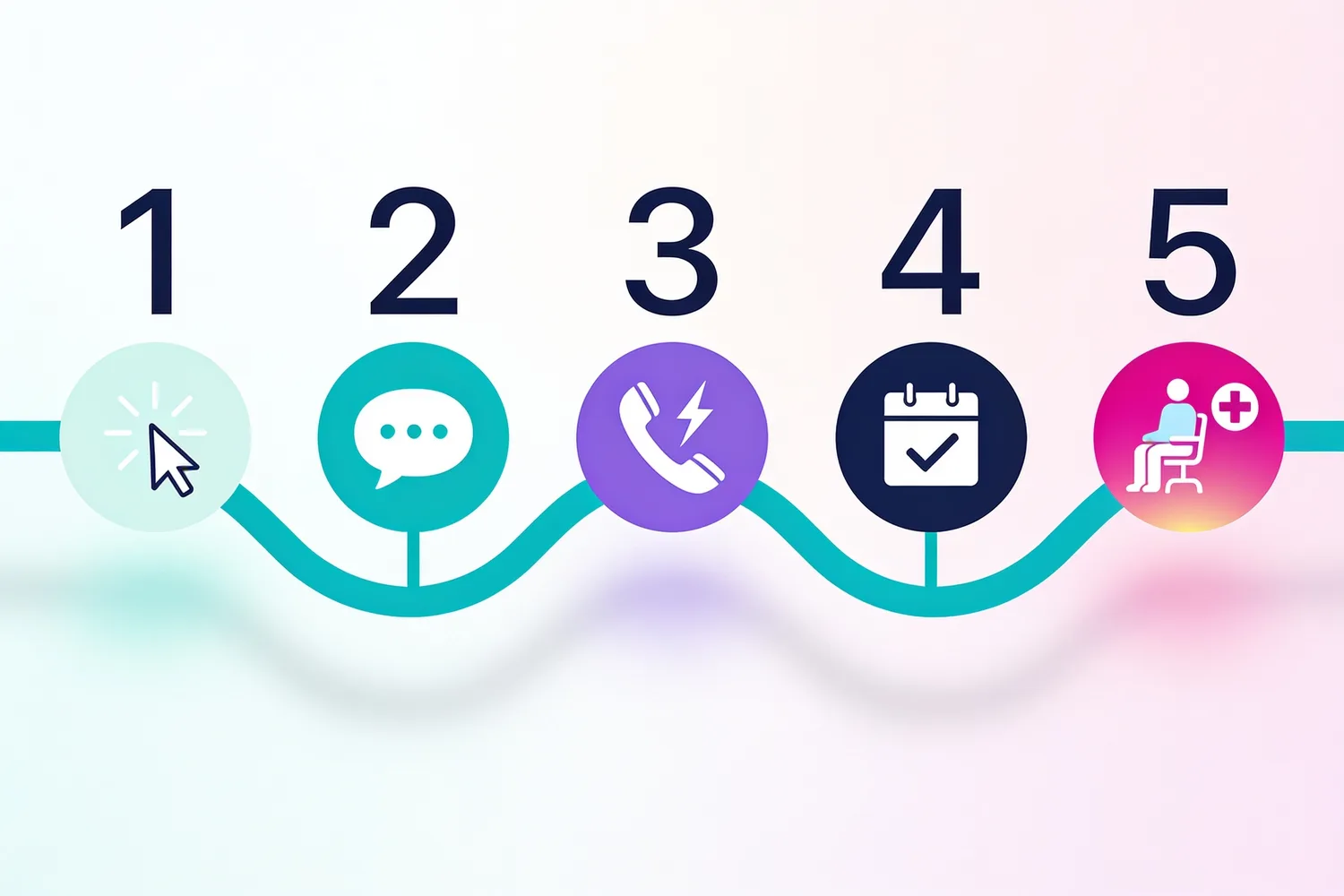
Here is the five-stage system with the math at each joint.
Stage 1: capture — where do healthcare leads come from?
- Owned (cheapest, compounding): your Google profile, treatment pages and content — local SEO plus education that ranks.
- Paid (fastest, meterable): patient-priced Google Ads and social campaigns amplifying proven content.
- Earned (highest trust): referrals, reviews and consented stories — demand that arrives pre-sold.
Every capture point funnels into two lanes: a call or a message. Both lanes must be instrumented — tracking numbers, tagged WhatsApp links, source fields — or the rest of the pipeline runs blind.
Stage 2: response — the five-minute cliff
Speed-to-lead is the highest-leverage number in healthcare marketing: an inquiry answered in five minutes converts at multiples of one answered in two hours, because the patient's next tab is your competitor. In working hours a human responds fast; after hours, the WhatsApp lane holds the patient till morning. In our audits, up to 60% of inquiries never get any follow-up — the single most expensive leak in the industry.
Stage 3: qualification — sorting without sorting out
Not every inquiry is your patient: wrong specialty, wrong city, price-only shoppers. Two or three natural front-desk questions ("What is the concern? Have you seen a doctor for it?") route people correctly — including politely elsewhere. What qualification must never become is coldness: in healthcare, today's wrong-fit inquiry is next year's right-fit family.
Stage 4: booking — collapse the distance
From "yes" to a confirmed slot should be one message long. Offer the next two available slots rather than asking "when would you like?", confirm instantly in writing, and capture the source in the same motion. Every extra round-trip sheds another percentage.
Stage 5: show-up — the stage everyone forgets to count
A booking is not a patient; no-shows run 20–35% unmanaged. A 24-hour reminder with one-tap reschedule, and a same-week re-offer for missed slots, reliably recovers a third of them. Cost per attended patient — not per lead — is the number the whole pipeline reports to (the five-number report).
What tooling does the pipeline actually need?
Less than vendors claim. A working healthcare pipeline runs on four inexpensive pieces: a call-tracking number per major channel (so "where did you hear about us?" stops being the attribution system), tagged WhatsApp links and UTM parameters on every campaign, one shared sheet or lightweight CRM where every inquiry gets a row with source, status and next action, and WhatsApp Business labels to keep conversations sorted. The discipline matters more than the software: a front desk that fills the source field on every inquiry beats an expensive CRM nobody updates. Add call recording where consent and law permit — fifteen minutes of listening to real inquiry calls teaches more about pipeline leaks than any dashboard.
What you should not buy yet: marketing automation suites, chatbots that frustrate anxious patients, and AI dialers. Automate reminders and follow-up nudges; keep the first human contact human — in healthcare, the empathy in the first thirty seconds is the conversion event.
The mistakes that keep OPDs empty despite good marketing
- Counting leads, not patients: a practice celebrating 200 monthly inquiries while 60% go unanswered is celebrating the leak.
- One lane only: phone-only practices lose the typed-message generation; WhatsApp-only lose the older caller. Run both, instrument both.
- No same-day follow-up rule: the inquiry answered tomorrow belongs to the competitor who answered today.
- Treating no-shows as fate: reminders plus one respectful re-offer recover a third of them — the cheapest patients the practice will acquire this year.
- Scaling spend onto a leaking funnel: more budget on an unanswered phone buys more unanswered calls — fix the system first.
The pipeline math, worked
100 clicks → 25 inquiries → 80% answered fast → 20 qualified conversations → 14 bookings → 11 attended. Improve just two joints — response speed and reminders — and the same 100 clicks yield 15–16 attended patients. Nothing about the marketing changed; the pipeline did. That is why we fix pipelines before scaling spend, every time (the full system).
Want your pipeline measured stage by stage? The free practice audit reconstructs your real conversion rates from existing data — most owners discover a stage they did not know was leaking.

Written by Gaurav Malik
Chief Growth Magician · Founder & Growth Strategist
Founder & Growth Strategist at Digital Magicians — India's healthcare-only growth agency.
Reviewed and published by Seema Dahiya for performance.
Meet the full team