
Most hospital marketing is a department producing posters. The hospitals that grow run systems. Here are the 12 that actually fill OPDs in India — in the order to build them.
Here is an uncomfortable pattern we see in almost every hospital audit we run. The hospital has a marketing team. The team is busy. Posters get made, festival posts go out, an agency sends a monthly report full of reach.
And the OPD? Flat.
The problem is almost never effort. It is that effort without a system does not compound. A campaign spikes and dies. A system keeps producing whether or not anyone is watching.
After 500+ practice audits and engagements across 18+ specialties, these are the 12 systems that reliably move OPD footfall for Indian hospitals — with the order we install them, because sequence matters more than most agencies admit.
1. Recover and own your Google Business Profile
Start here, because everything else feeds it. Your Google Business Profile is the single highest-traffic page you own — for most hospitals it generates more calls than the website.
Verify ownership sits with the hospital, not an old vendor. We once spent six weeks recovering a profile a previous agency had locked for four years — while ~200 reviews sat unanswered and the rating drifted to 3.7★. Within 60 days of recovery, that hospital was ranking #1 for its priority searches. The full case study is here.
Then complete it like a product page: precise categories, every department as a service, photos updated monthly, Q&A answered by you before strangers answer it for you.
2. Build a review engine, not a review request
Reviews arrive by design or they barely arrive at all. The system: every discharged patient gets a next-day WhatsApp message with a one-tap path to review. Front desk scripts make the ask natural. Every review — positive or negative — gets a professional response.
Two hard rules. Never buy or fabricate reviews: it violates Google policy, consumer law and basic ethics, and it is detectable. And never reveal patient details in responses — DPDP applies to replies too.
3. Give every senior doctor an authority page
Patients do not choose hospitals. They choose doctors they feel they already know. A dedicated, search-optimized page for each consultant — credentials, conditions treated, honest FAQs, booking path — means the doctor’s name search lands on you, not on an aggregator that also lists your competitors.
4. Publish departmental service pages that answer real questions
"Cardiology department" pages written like brochures rank for nothing. Pages that answer what patients actually type — cost ranges, recovery timelines, what to expect, insurance and TPA answers — rank and convert. One page per department, built on the questions your front desk hears daily.
5. Run a health library that compounds
A weekly, medically reviewed article program builds the topical authority Google demands from health content. Every article carries an author byline, a reviewer credit and honest sourcing — the E-E-A-T signals that decide health rankings. This is a 6-month compounding asset, so it starts early, not after ads.
6. Put doctors on camera — with a machine behind them
Doctor-led short video is the fastest trust builder in Indian healthcare right now. The catch: doctors do not have time to be creators. The system is batch shoots — one session a month, 10–15 scripted reels with hooks in the language patients speak — edited and published by a team, not by the doctor.
We watched this engine take a gynaecologist from 5,500 followers to a 1.8-million-view medical voice in five months — with 30–40 consultations a month walking in from content alone.
7. Open the WhatsApp lane
Working patients cannot call during clinic hours. WhatsApp booking — a click-to-chat button on the profile, website and every ad — lets them book at midnight. Response templates and a 5-minute acknowledgment rule stop the leak between inquiry and appointment.
8. Track every call, or you are marketing blind
A dedicated tracking number for marketing channels, with recordings and a simple CRM, answers the only question that matters: which rupee produced which patient. It also exposes the silent killer — missed and unanswered calls, which in our audits run as high as 60% of inquiries.
9. Buy demand at patient prices, not click prices
Google and Meta ads work for hospitals when they are priced per attended consultation and pointed at high-intent searches — "chest pain hospital near me", "knee replacement cost". They fail when they are priced per click and pointed at everyone. Fix the funnel first (systems 1–8), then scale spend into it. Never the reverse.
10. Turn satisfied patients into a referral loop
Discharge is not the end of the journey. A structured follow-up — recovery check-ins, review invitation, a shareable summary of the doctor’s advice — turns one patient into a family’s hospital. Health content that families forward ("send this to papa") is referral marketing wearing an education costume.
11. Run recall and retention like a department
Annual health checks, chronic-care reviews, vaccination schedules, seasonal campaigns — recall systems fill predictable OPD capacity at near-zero acquisition cost. Most hospitals have the patient data and never use it. (Use it lawfully: DPDP consent governs every message.)
12. One dashboard, one number
Reach, impressions and likes are diagnostic exhaust. The dashboard that matters shows inquiries, booked appointments, attended appointments and cost per attended patient — by channel, monthly. If your agency cannot produce that dashboard, you do not have a marketing problem. You have a measurement problem.
The order matters: a 90-day sequence
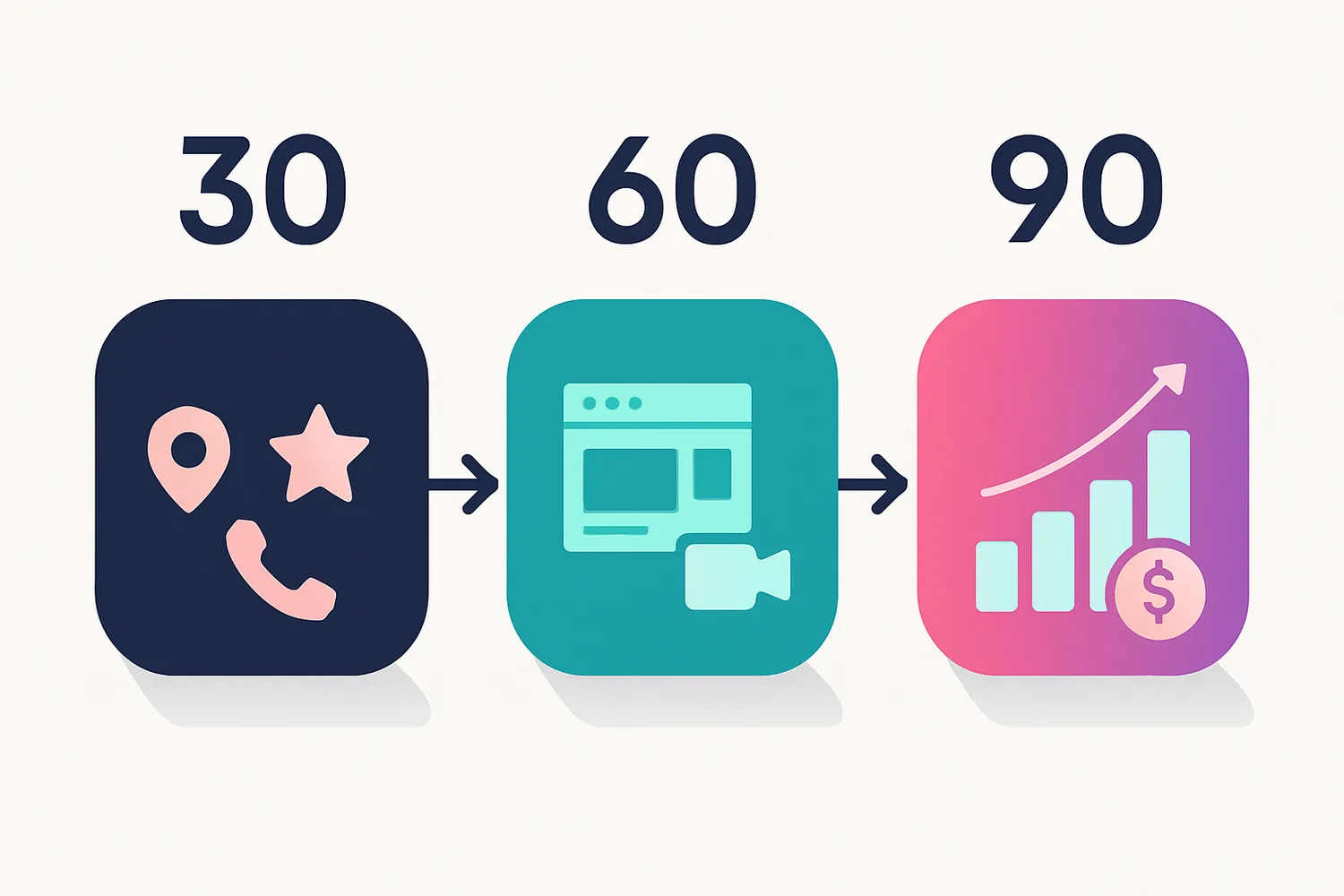
- Days 1–30: profile ownership, review engine, call tracking, WhatsApp lane. Foundations that catch demand you already have.
- Days 31–60: doctor authority pages, departmental pages, first batch video shoot.
- Days 61–90: health library cadence, paid campaigns onto the now-instrumented funnel, first KPI review against written targets.
Notice what is absent from the first 30 days: ads. Spending into a leaking funnel is the most expensive mistake in hospital marketing.
The five mistakes that undo all twelve systems
We see the same failure patterns in hospital after hospital. Avoid these and you are ahead of most of your market:
- Scaling ads into a leaking funnel. Doubling spend when 60% of inquiries go unanswered doubles the waste, not the patients.
- Letting a vendor own your accounts. Profiles, ad accounts and content must belong to the hospital. Agencies earn retention with results, not hostage-keeping.
- Measuring reach instead of appointments. A report full of impressions is decoration. If the dashboard cannot connect channel to attended patient, replace the dashboard.
- Treating compliance as an afterthought. One "best hospital in the city" claim can cost more goodwill with regulators and peers than a year of ads can buy.
- Stopping at 90 days. Content, reviews and rankings compound. The hospitals that win are the ones still publishing in month eight, when competitors have quit.
How much should a hospital budget for all this?
Size the budget to the patient math, not to a percentage rule. A mid-size hospital typically needs ₹2L+ a month all-in to run systems 1–12 properly — but the sequencing above means the first 60 days are mostly one-time system building, not media spend. The output to hold any budget against: cost per attended patient, by department. We wrote a fuller budgeting framework in our guide to marketing budgets for Indian practices.
What this looks like when it works
The hospital we mentioned earlier — 45 years old, NABH-certified, digitally invisible — ran exactly this sequence. Sixty days later: #1 local rankings, 200 → 274 reviews, 200+ tracked calls a month, 33 online appointments in a month with ₹0 ad spend. Systems, not campaigns.
If you want to know which of the 12 systems your hospital is missing, that is literally what our free practice growth audit maps — benchmarked against your city and delivered in five days. Or read our take on hospital digital marketing as a specialty first.

Written by Gaurav Malik
Chief Growth Magician · Founder & Growth Strategist
Founder & Growth Strategist at Digital Magicians — India's healthcare-only growth agency.
Reviewed and published by Seema Dahiya for performance.
Meet the full team